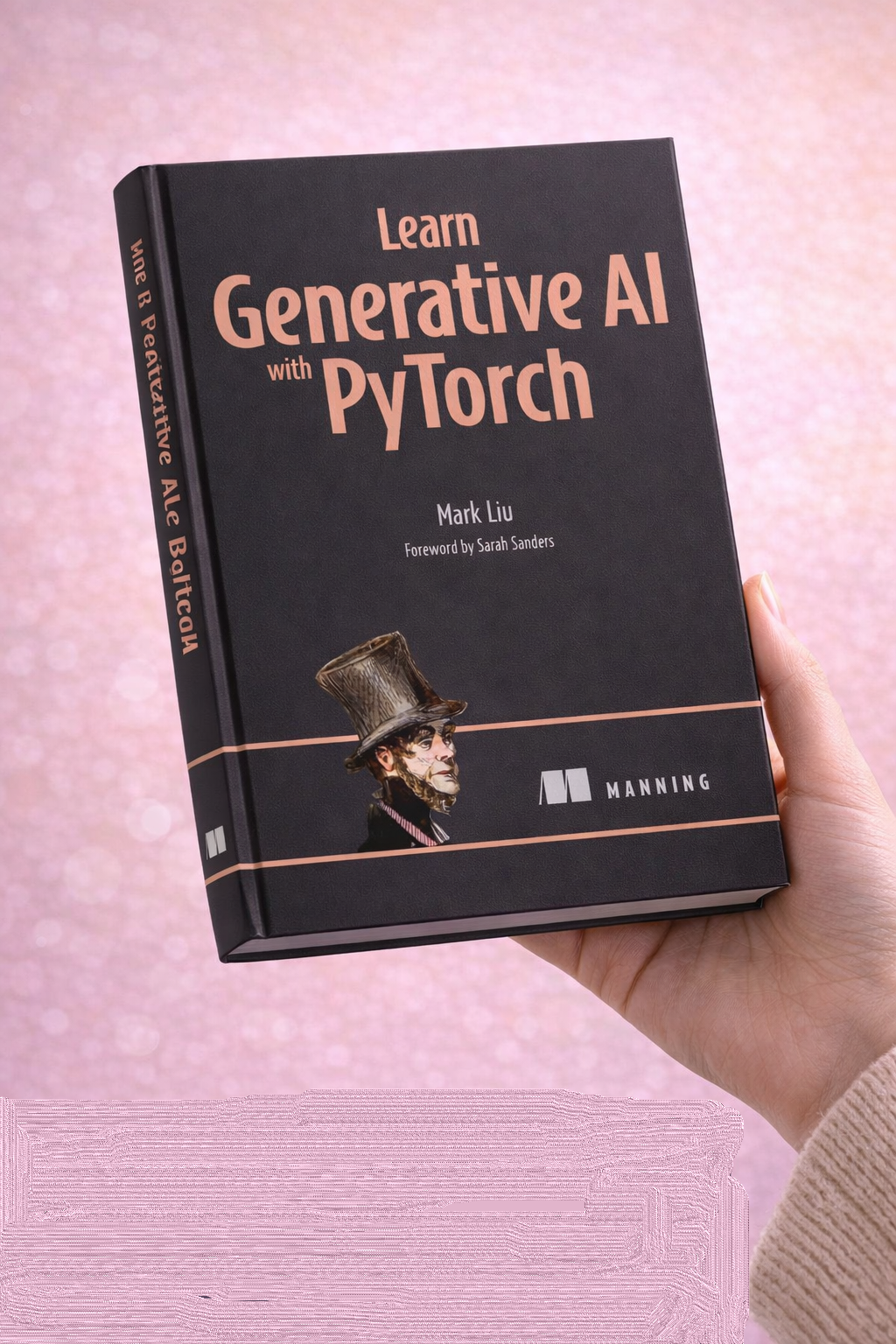
Learn Generative AI with PyTorch: A Beginner-Friendly Engineering Guide
Introduction
Generative Artificial Intelligence (Generative AI) is one of the most exciting fields in modern engineering and computer science. From generating realistic images and human-like text to composing music and designing molecules, generative models are changing how engineers build intelligent systems.
If you are a student or a professional engineer who wants to learn Generative AI with PyTorch, this article is written for you. PyTorch is one of the most popular deep learning frameworks today, widely used in both research and industry due to its simplicity, flexibility, and strong community support.
This guide is beginner-friendly, but it does not avoid engineering depth. You will learn:
-
What Generative AI really is
-
The theoretical background behind generative models
-
How PyTorch fits into the picture
-
Step-by-step workflows
-
Practical examples
-
Real-world applications
-
Common mistakes and challenges
-
A real engineering case study
By the end of this article, you will have a solid conceptual foundation and a clear learning roadmap to start building generative models using PyTorch.
Background Theory
What Is Artificial Intelligence?
Artificial Intelligence (AI) refers to systems that can perform tasks that normally require human intelligence, such as:
-
Learning from data
-
Recognizing patterns
-
Making decisions
-
Understanding language
AI is a broad field that includes:
-
Rule-based systems
-
Machine Learning (ML)
-
Deep Learning (DL)
Generative AI belongs to Deep Learning, which uses neural networks with many layers.
From Discriminative to Generative Models
To understand Generative AI, it is important to distinguish between two major model types:
Discriminative Models
-
Learn the boundary between classes
-
Example: Spam vs. Not Spam
-
Learn:
P(y∣x)
Generative Models
-
Learn how the data itself is distributed
-
Can generate new data samples
-
Learn:
P(x)orP(x∣y)
Key idea:
Generative models learn how data is created, not just how it is classified.
Why Generative AI Matters in Engineering
Generative AI enables engineers to:
-
Simulate complex systems
-
Generate synthetic data
-
Design new products faster
-
Reduce cost and experimentation time
In modern engineering projects, generative models are used for:
-
Image synthesis
-
Code generation
-
Natural language systems
-
Drug discovery
-
Digital twins
Technical Definition
What Is Generative AI?
Generative AI is a class of artificial intelligence models designed to learn the underlying probability distribution of data and generate new, realistic samples similar to the training data.
Formally, given a dataset:
X={x1,x2,…,xn}
A generative model learns a distribution:
pθ(x)
where:
-
x is a data sample
-
θ are model parameters
Once trained, the model can sample new data from this distribution.
Common Types of Generative Models
1. Autoencoders (AE)
-
Encoder compresses data
-
Decoder reconstructs data
2. Variational Autoencoders (VAE)
-
Probabilistic version of autoencoders
-
Uses latent distributions
3. Generative Adversarial Networks (GANs)
-
Two networks: Generator & Discriminator
-
Trained in competition
4. Diffusion Models
-
Add noise gradually
-
Learn to remove noise step by step
PyTorch supports all these architectures efficiently.
Why PyTorch for Generative AI?
PyTorch is preferred by engineers because:
-
Dynamic computation graphs
-
Python-friendly syntax
-
Strong GPU acceleration
-
Large ecosystem (TorchVision, TorchText, TorchAudio)
-
Easy debugging
Step-by-Step Explanation
Step 1: Understand the Data
Every generative project starts with data.
Key questions:
-
What type of data? (images, text, signals)
-
Data size and quality
-
Data distribution and noise
Engineers must preprocess data carefully:
-
Normalization
-
Scaling
-
Tokenization (for text)
Step 2: Choose a Generative Model
Your choice depends on the problem:
| Task | Recommended Model |
|---|---|
| Image generation | GAN, Diffusion |
| Representation learning | VAE |
| Text generation | Transformer-based models |
| Data compression | Autoencoder |
Step 3: Define the Model in PyTorch
In PyTorch, models are built using:
-
torch.nn.Module -
Layers such as Linear, Conv2D, LSTM
Conceptually:
-
Define layers
-
Define forward pass
-
Initialize parameters
Step 4: Define the Loss Function
Loss functions guide learning.
Examples:
-
Mean Squared Error (Autoencoders)
-
Binary Cross Entropy (GANs)
-
KL Divergence (VAEs)
Mathematically:
L=Reconstruction Loss+Regularization
Step 5: Train the Model
Training loop consists of:
-
Forward pass
-
Loss computation
-
Backpropagation
-
Parameter update
PyTorch handles gradients automatically using:
∂L/∂θ
Step 6: Generate New Samples
After training:
-
Sample from latent space
-
Pass through generator/decoder
-
Obtain new data
This is where Generative AI becomes visible.
Detailed Examples
Example 1: Autoencoder for Data Compression
Autoencoders consist of:
-
Encoder: x→z
-
Decoder: z→x
Goal:
min∣∣x−x^∣∣
Engineering use:
-
Noise reduction
-
Feature extraction
Example 2: Variational Autoencoder (VAE)
VAEs introduce probability distributions.
Latent variables:
z∼N(μ,σ2)
Loss function:
L=Reconstruction Loss+DKL(q(z∣x)∣∣p(z))
Engineering benefit:
-
Smooth latent space
-
Controlled generation
Example 3: GAN for Image Generation
GANs involve:
-
Generator G(z)
-
Discriminator D(x)
Objective:
GminDmaxE[logD(x)]+E[log(1−D(G(z)))]
Engineering challenge:
-
Training instability
-
Mode collapse
Real-World Applications in Modern Projects
1. Software Engineering
-
Code generation tools
-
Bug fixing suggestions
2. Electrical Engineering
-
Signal synthesis
-
Fault detection data generation
3. Mechanical Engineering
-
Generative design optimization
-
CAD shape generation
4. Civil Engineering
-
Synthetic sensor data
-
Structural simulations
5. Medical & Biomedical Engineering
-
Medical image synthesis
-
Data augmentation
Common Mistakes
1. Ignoring Data Quality
Poor data leads to poor generation.
2. Overtraining the Model
Results in memorization instead of generation.
3. Wrong Loss Functions
Misaligned loss prevents convergence.
4. Unrealistic Expectations
Generative models require time and tuning.
Challenges & Solutions
Challenge 1: Training Instability
Solution:
-
Learning rate scheduling
-
Gradient clipping
Challenge 2: Mode Collapse
Solution:
-
Improved GAN variants
-
Better discriminator balance
Challenge 3: High Computational Cost
Solution:
-
Use GPUs
-
Reduce model size
-
Mixed precision training
Challenge 4: Evaluation Difficulty
Solution:
-
Use metrics like FID, BLEU
-
Human evaluation
Case Study
Case Study: Image Generation for Engineering Diagrams
Problem:
An engineering firm needed synthetic training data for diagram recognition.
Approach:
-
Collected labeled diagrams
-
Trained a VAE using PyTorch
-
Generated synthetic diagrams
Results:
-
Increased dataset size by 5×
-
Improved model accuracy by 18%
-
Reduced manual labeling cost
Engineering Lesson:
Generative AI can significantly reduce data bottlenecks.
Tips for Engineers
-
Start with simple models
-
Visualize outputs frequently
-
Track experiments carefully
-
Learn probability basics
-
Read PyTorch documentation
-
Understand math before optimization
FAQs
1. Is PyTorch good for beginners?
Yes, PyTorch is beginner-friendly and widely used in academia and industry.
2. Do I need advanced math for Generative AI?
Basic linear algebra, probability, and calculus are sufficient to start.
3. Can Generative AI be used without GPUs?
Yes, but GPUs significantly speed up training.
4. Which generative model should I learn first?
Start with Autoencoders, then move to VAEs and GANs.
5. Is Generative AI safe to use in production?
Yes, with proper validation, monitoring, and ethical considerations.
6. How long does it take to learn Generative AI?
Foundations can be learned in weeks; mastery takes months of practice.
Conclusion
Learning Generative AI with PyTorch is a powerful investment for students and engineers. Generative models are no longer experimental tools; they are core components of modern engineering systems.
By understanding:
-
Theoretical foundations
-
Model architectures
-
Training workflows
-
Practical challenges
You gain the ability to create, not just analyze, data.
Start small, practice consistently, and build real projects. PyTorch provides the flexibility and power needed to turn Generative AI concepts into working engineering solutions.
The future of engineering is not just about solving problems—it is about generating new possibilities.